
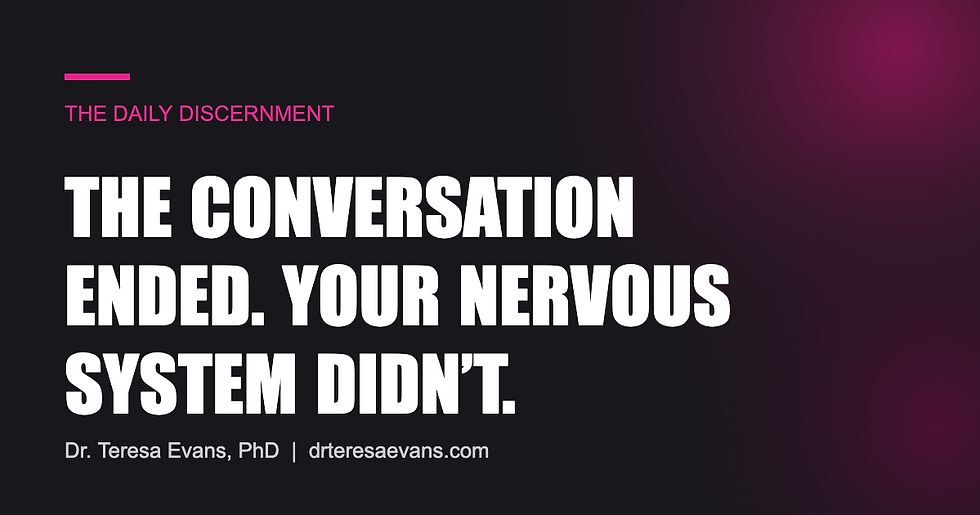
The Conversation Ended. Your Nervous System Didn’t.

For the moments when nothing bad happened, but your body still reacts as though something did.
Last week, we talked about becoming more compassionate toward ourselves when an old pattern returns. The goal isn’t to never get triggered. It’s to notice what’s happening sooner, recover more intentionally, and stop treating every difficult reaction as evidence that we’ve failed.
This week, I’ve been thinking about what happens when the difficult moment itself appears to go perfectly fine.
Recently, I had a conversation that was cordial and productive. I stayed calm, focused on the facts, and said what needed to be said. There was no argument. No major conflict. Nothing objectively bad happened.
But after the conversation ended, my body reacted as though something had.
My chest felt tight. My energy dropped. My thoughts became louder, and I started replaying small pieces of the conversation, searching for something I might have missed. For the next few hours, my body seemed to remain braced for a threat that never arrived.
Then came the judgment:
Why am I still reacting this way?
The conversation was fine.
Shouldn’t I be able to handle this by now?
As I sat with it, I realized something.
The conversation had ended, but my nervous system hadn’t received the message yet.
Maybe you’ve experienced this too. The meeting ends. The call disconnects. The decision is made. Everyone else moves on. But some part of you is still in the room.
What’s Happening in the Brain
The brain doesn’t evaluate the present using only what is happening right now. It also uses the past to predict what might happen next.
When a person, environment, or type of conversation has previously been connected to conflict, criticism, volatility, or feeling powerless, your nervous system may prepare for the old outcome even when the current interaction remains calm.
Your thinking brain may recognize: This is simply a conversation. Your body may still be saying: Be careful. This hasn’t always felt safe.
High-capacity people can function remarkably well while this is happening. We can remain articulate, make decisions, manage the room, and choose our words carefully. From the outside, we may look completely composed. Sometimes it’s only after the interaction ends that the body reveals how much energy it required.
Nothing bad happened, but my body still feels like something did. External composure and internal regulation aren’t always the same thing.
This doesn’t mean your reaction is irrational. It means your nervous system is using what it previously learned to protect you. The work is helping it recognize when the current moment is different.
Coherence Check
This week, instead of asking why I was still reacting, I tried asking: What might my nervous system still be predicting?
That question created a little space between what had actually happened and what my body expected to happen. I could acknowledge that my body was responding at an eight out of ten while also recognizing that the current situation probably deserved a three. I didn’t need to force myself down to zero. I simply needed to help my body begin recalibrating.
Sometimes that means walking, stretching, slowing my breathing, stepping outside, or drinking a glass of water without simultaneously analyzing the entire interaction.
The physical transition matters. Your body may need a clear signal that the conversation is over before your mind begins deciding what it meant.
Do not make strategic conclusions from a body that is still inside the previous conversation.
Give yourself time to settle before deciding what happened, what it means, or what you need to do next.
Signals I’m Paying Attention To This Week
A calm interaction can still carry a physiological cost.
External composure doesn’t necessarily mean we felt safe internally.
Sometimes recovery requires a physical transition, not more analysis.
Self-judgment rarely helps an already activated nervous system settle.
The goal isn’t to become someone who is never affected. It’s to become someone who can notice the activation, understand what it needs, and return to themselves before choosing what happens next.
Because regulation isn’t proof that nothing touched you. It’s the ability to come back to yourself after it does.
A Question to Sit With
Before you move on with your week, spend a few quiet minutes with this question:
What conversation, responsibility, or environment is your body still carrying after it has technically ended?
Just notice what comes up. Then ask: What might help my nervous system recognize that this moment is complete?
Sometimes the most strategic thing we can do isn’t solve the next problem. It’s make sure we’re no longer responding to the previous one.
From My Coaching Notebook
Before deciding what a difficult interaction meant, ask whether your body has actually returned to baseline.
When we interpret an interaction while we’re still activated, the brain is more likely to overestimate threat and build a story around what might happen next. You don’t have to ignore your instincts. Just give your body time to settle before asking your mind to reach a conclusion.
Remember, Your Presence Is Your Super Power
— Teresa
Comments